How to reverse engineer your company's performance system and actually get paid more
Performance reviews may be the most misunderstood game you'll play during your career. The house almost always wins and when you win, it's rarely because you played by the rules.
This is not a takedown of HR systems. Shooting holes in those is like firing insults at the Toronto Maple Leafs. It’s satisfying, but hardly a challenge.
This is the hacker side. For us mere employees, the goal is simple: get paid more.
Welcome to the delicate art of temporarily giving a shit about a system you do not give a fuck about, so you can buy more of the things you actually do give a fuck about.
I've sat on both sides of this table, as the one being reviewed and the one doing the reviewing, and let me tell you, these exercises are not nearly as deep as they appear to be.
I recently came across Sam Gregg Wallace's piece on dismantling HR and building something better. It's a thoughtful look at how hard it actually is to design a fair system. And he's right, it is hard. But that's HR’s problem. Yours is figuring out how to work the one in front of you.
If you're early in your career and trying to figure out how this game actually works, this one's for you!
Wallace was riffing on Mark Manson's The Subtle Art of Not Giving a Fuck. And this post is my riff on Wallace. Consider it a field guide for the employee side of the table.
Calibration Season
For most people, performance reviews have very little to do with your actual performance. Companies use them primarily to determine who deserves a compensation increase, who has earned a promotion, who’s next up on the chopping block, and to make sure all of that is on record for the next review cycle.
Sometimes they do coincide with a genuine assessment of your work. If you're at one of those rare companies that actually treats reviews as a development tool, good for you. This post is going to be less helpful.
Most managers are overstretched with too many direct reports to pull their reviews together coherently. What you usually get is a bullet point highlight reel of things you worked on during the cycle, or at least your manager's recollection of them. The feedback itself is frequently recycled from the growth points you provided yourself, padded out with the kind of coaching classics they never got around to giving you during the actual cycle, like 'you need to be more transparent about what you're working on' or 'you should be mentoring your teammates more.
So don't lose sleep over it. The review is a reflection of your manager's bandwidth, not your actual performance.
So What Actually Gets You Paid?
Knowing what reviews are actually for changes how you prepare for them.
Think of it this way: Grant me the serenity to accept the systems I cannot change, the cunning to exploit the ones I can, and the wisdom to know the difference.
Don't take your manager's feedback as gospel. Hitting all those points is unlikely to result in a large raise or promotion on its own. And don't dwell on the projects that didn't ship according to plan. What projects do?
The golden trifecta of a good performance cycle comes down to three things:
- Work on the right things.
- Work on them at the right time.
- Work on them when the right people are watching.
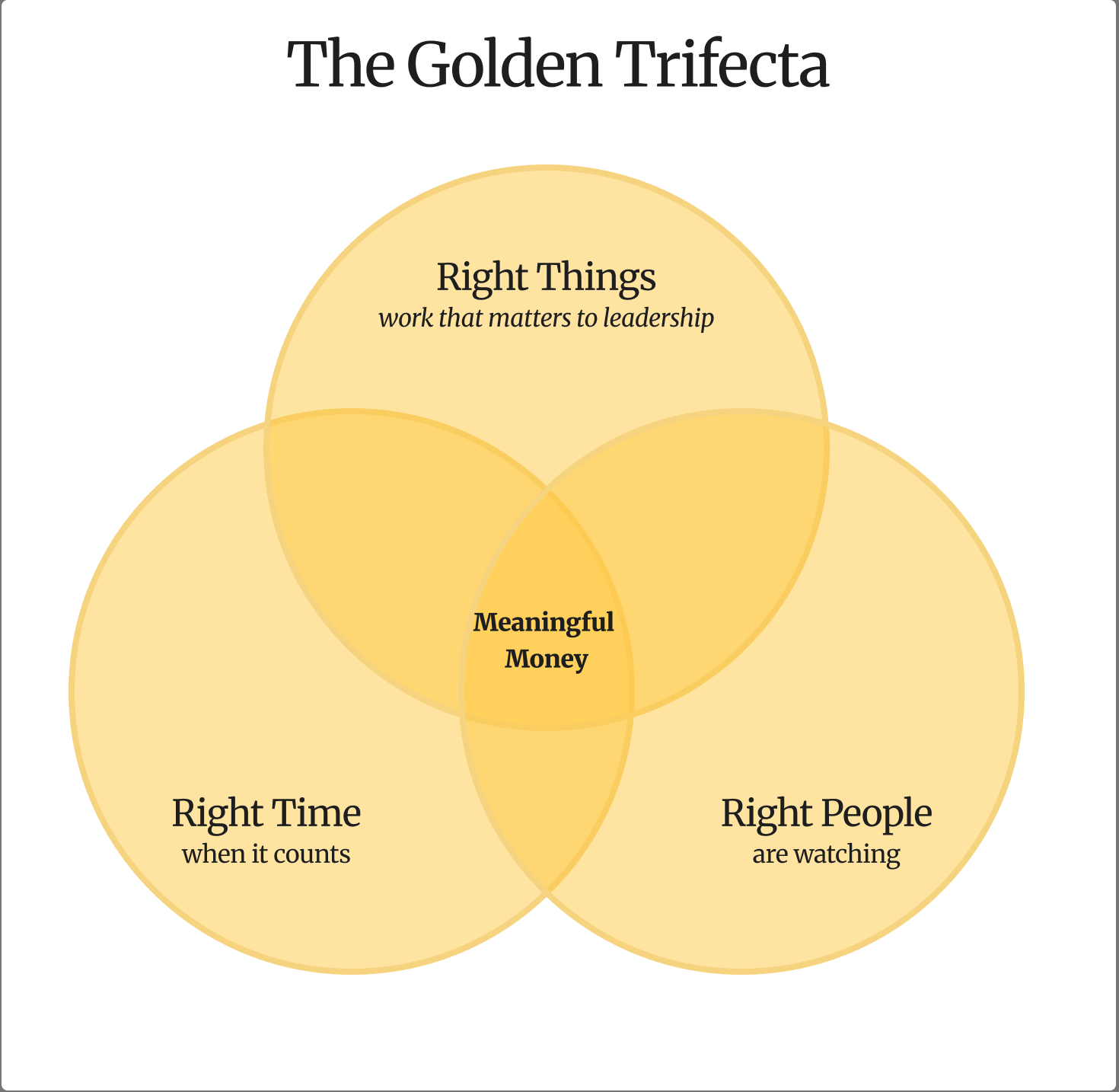
The trifecta isn't about keeping your job or getting your annual bump. Most folks already get that. It's specifically the combination that unlocks serious money or a promotion. Miss one and you're not losing anything. You're just not gaining significant ground.
So how do you know if you're actually on track for it?
Are these things hard to measure? A little. But there are ways to gauge your standing before, during, and after your review.
Start by stopping. Stop measuring your performance by the things you ship, the quality of your work, or the ratings you receive. I know… that would be too intuitive. HR systems are allergic to intuition.
Instead, measure your performance by what you observe.
It is far easier to read your standing through how others interact with you than through any formal review. Are you the first person your boss calls when something needs to get done? You are performing well. Are you pulled into impromptu meetings about critical or urgent work? You are performing well. Do you get access to sensitive information before it reaches the wider team? You are performing well. Are you handed the reins when your boss goes on leave? You already know the answer.
These are not coincidences. They are signals that people want you for the right work, that they bring you in when it matters most, and that the people who hold the reins trust you to get things done.
And here's the distinction worth holding onto: Expertise reflects your ability to deliver quality work and the knowledge you bring to problems. Performance reflects the trust people have in you, and the access to important context that puts you on the right projects at the right time.
Think of it like a security clearance. Your qualifications get you through the gate. The level of access you're granted once you're inside tells you far more about how you're actually perceived.
Re Performance Reviews: So What Should I Actually Give a Fuck About?
Not much. If you're meeting expectations or above, ask about your raise and move on.
The only rating worth paying attention to is not meeting expectations. Take it as a signal that your company or management is already considering moving you out, especially if it comes out of nowhere. Sometimes this reflects your actual performance, and if so, you probably already saw it coming. But sometimes it's something else entirely: the company bending the HR process to justify a decision they've already made. The role might have been considered redundant before the review cycle even started. The review just gives it a paper trail.
Either way, now you know.
Is there anything you can take from performance reviews?
Actually, yes. Use this time to collect peer feedback. Feedback from the people you actually work with doesn't just give you useful insight into your craft, it builds trust and rapport. Asking people to weigh in on your career journey gets them invested in your future. Get feedback you really liked? Ask that person to mentor you. That kind of relationship will have a more meaningful impact on your career than any rating ever will.
Just don't rely on your company for credible feedback on your performance. Don't let raises, levels, or scores dictate how you see yourself.
I also use this time for what I call trickle-down acceleration. Just as you are going through this process, so is your manager. And their manager. And their manager's manager. Your boss is working on their own golden trifecta just as much as you are. So ask them what feedback they got from their boss. Ask how you can help them deliver on it. That's not just good strategy, it's one of the best trust-building moves you can make.
None of this shows up in your performance rating. All of it shows up in your career.
If this resonated, send it to someone stuck in their review cycle!